Why Your ADHD Sleep Schedule Runs About 90 Minutes Late — And How to Stop Fighting It
You've set seven alarms. Your phone's been buzzing since 6:47am. You're still awake at 2am, scrolling through Wikipedia rabbit holes about 19th-century maritime law, wondering why you can't just be normal. At 11am, you finally drag yourself out of bed, groggy and furious at yourself.
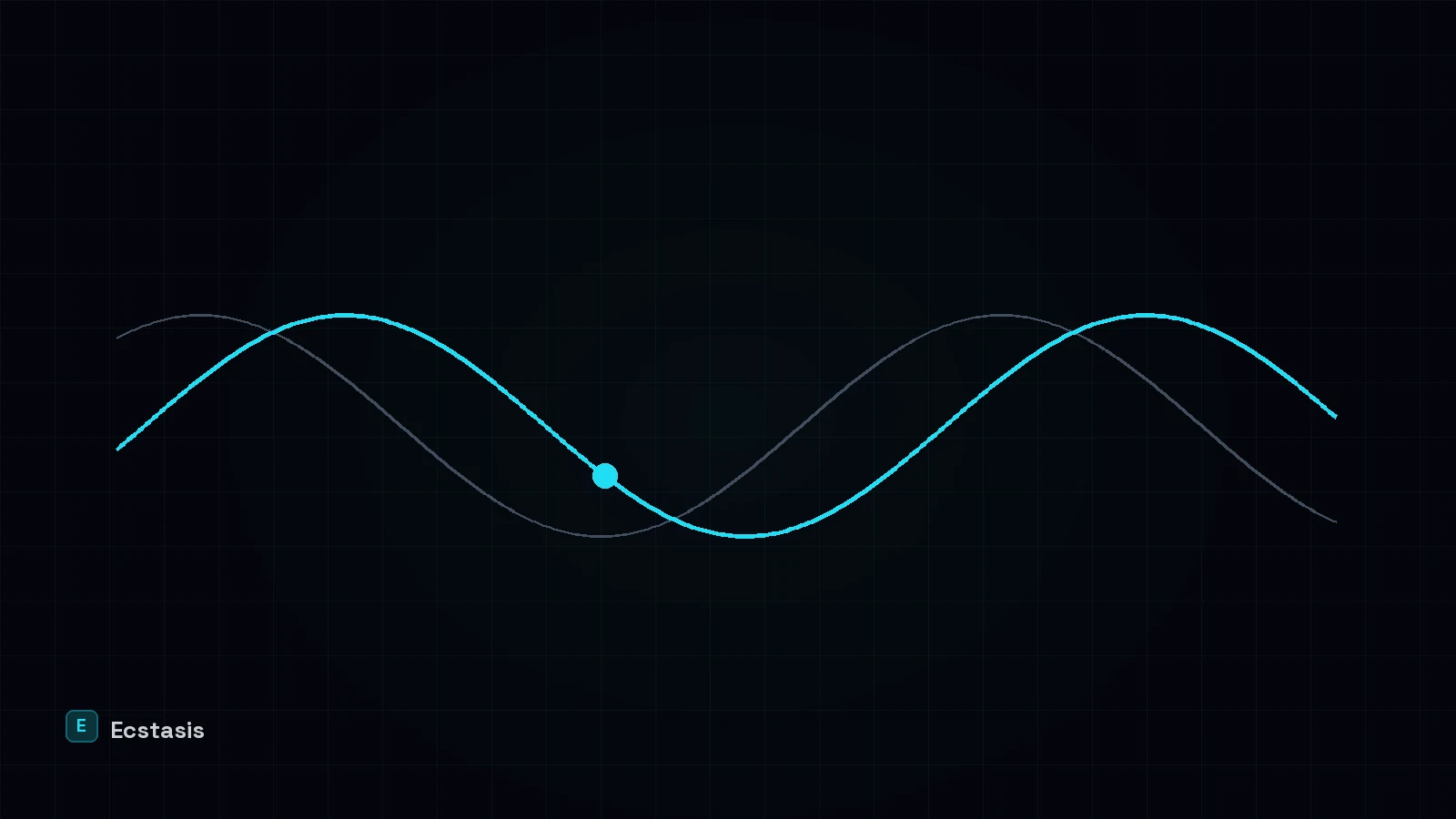
Here's the thing: you're not lazy. You're not broken. Your body clock just runs about 90 minutes later than everyone else's.
This isn't motivation failure. This isn't a character flaw. This is neurobiology.
Your Brain Isn't Lazy — It's Late
If you have ADHD, your circadian rhythm—the internal biological clock that tells your body when to sleep, wake, and peak mentally—is genuinely delayed. We're not talking about a preference for staying up late. We're talking about a measurable, neurobiological phase shift in the timing of your melatonin and your sleep-wake cycle.
The phase delay itself is one of the better-replicated findings in the field. Across 62 studies and 4,462 patients, ADHD is consistently associated with a later chronotype and with phase-delayed circadian markers, including dim-light melatonin onset (Coogan & McGowan, 2017). Review-level estimates put that melatonin onset delay at roughly 90 minutes in adults, and around 45 minutes in children (Luu & Fabiano, 2025) — not because you're fighting bedtime, but because your brain's natural rhythm is shifted later.
How many people it affects is harder to pin down. A UK expert consensus puts delayed sleep onset — plain difficulty falling asleep — at up to 78% of people with ADHD (Asherson et al., 2025). That figure comes from clinical samples and expert opinion rather than population surveys, and difficulty falling asleep is a symptom rather than a diagnosed sleep disorder. Read it as "very common in the clinic", not as a population rate.
This isn't a bug in your neurology. It's the schedule your body actually runs on.
Sleep hygiene advice—"go to bed at the same time," "no screens before bed," "get morning sunlight"—was written for neurotypical people whose circadian rhythms align with conventional work schedules. For ADHD brains operating on a 90-minute delay, that advice is like telling someone with red-green colourblindness that the traffic light is "definitely red if you just concentrate harder." The instruction itself misses the biology.
The Neuroscience of Your "Broken" Clock
Dopamine, Melatonin, and a Clock That Runs Late
ADHD involves dysregulation of dopamine signalling in the brain's reward and attention circuits — imaging work has found reduced dopamine markers in the reward pathway of adults with ADHD compared with controls (Volkow et al., 2009). That much is well established, and it isn't just about "motivation."
What is not established is a tidy causal chain running from dopamine to melatonin. The circadian delay in ADHD is well observed but not yet fully explained, and the evidence on causality points both ways: ADHD is associated with later sleep timing, and disturbed sleep is associated with more ADHD symptoms (Crinion et al., 2024). Nobody can currently tell you which came first in your case.
What the measurements do show is the timing. Normally, your pineal gland ramps up melatonin production through the evening, and by 10 or 11pm your sleep pressure is high enough to override the temptation of your phone. You sleep.
In ADHD, that rise tends to happen later — on average, roughly 90 minutes later in adults. Your "sleepy window" doesn't open until midnight or 1am, no matter how tired you think you are.
There's more, and it's less tidy than it sounds. The subjective experience of bad sleep in ADHD is robust and repeatedly replicated. The objective picture is weaker. A meta-analysis in children found ADHD groups worse than controls on most subjective sleep measures and only some objective ones (Cortese et al., 2009). In adults, a meta-analysis of 13 studies found significant differences on most self-reported measures, on two actigraphic ones — and on none of the polysomnographic measures (Díaz-Román et al., 2018). One controlled sleep-lab study went further still: adults with ADHD showed increased nocturnal motor activity and rated their sleep as worse, yet recorded significantly more total sleep time than controls (Philipsen et al., 2005).
So the honest version is that sleep feels worse, and the sleep lab often doesn't see it. That gap — between how sleep feels and how it measures — is itself part of the ADHD picture.
Why Forcing Neurotypical Sleep Times Backfires
This is where the real damage happens. You're aware of the time. You know you have to be somewhere at 9am. So you do what every responsible person does: you try to go to bed earlier.
You get in bed at 10pm. You set your alarm. You lie there for three hours. Not scrolling. Not reading. Just... waiting. Your brain is neurobiologically not ready to sleep. Your melatonin hasn't risen. You're fighting against your own physiology.
By hour two of lying in the dark, the frustration starts. By hour three, you're entering RSD territory—rejection-sensitive dysphoria, the community's term (not a formal diagnosis) for the ADHD experience of shame and rage when things don't work the way you expected. You're not just awake; you're furious at being awake. You're failing at something that everyone else makes look easy.
So you do what your brain is screaming for: you get up, open your laptop, and finally—finally—your dopamine rises. You feel normal. You feel awake. And now it's 4am, and you have 4 hours until you need to be functioning.
This compounds when you add medication into the mix. Stimulants have a measurable effect on sleep: a meta-analysis of studies using objective sleep measurement in young people found stimulant treatment lengthened the time taken to fall asleep, lowered sleep efficiency and shortened total sleep time — although the effect was smaller in those who had been on medication longer (Kidwell et al., 2015). Layer that onto a clock that is already running late and the squeeze is obvious. You're awake at night, exhausted in the morning, and you blame yourself for "not taking it seriously." That squeeze is a conversation to have at a medication review — never a reason to change anything on your own.
Or you self-medicate with caffeine, and that makes falling asleep harder still. Now it's not just your brain that's delayed; it's your behaviour that's entrenching the delay.
What Your Delayed Rhythm Actually Means
The Chronotype Sweet Spot
Here's what neurotypical productivity culture got wrong: they assumed everyone's brain works the same way across the day.
Research on chronotype and cognitive performance finds a synchrony effect: people perform best when a task's timing lines up with their own circadian peak, not some single universal best time of day (Goldstein et al., 2007). That work was done in adolescents and wasn't about ADHD — and, importantly, it doesn't put anyone's peak at a particular hour. It says the peak is individual, and that matching the task to it is what matters.
Which is the useful part. If your circadian phase is shifted later, your best window is very likely later than the 9-to-1 default that offices are built around. Where exactly is your own question to answer. No research locates an ADHD cognitive peak at a specific clock time, which is precisely why this is worth observing rather than assuming.
This isn't because you're "supposed to" be creative at night. It's because that's when your body clock has you properly awake — whenever that turns out to be.
And yes, when you hit that window, you can focus. You can write. You can solve problems. You want to work. This isn't a disorder; this is your biological peak. In a world designed around the ADHD rhythm instead of the neurotypical rhythm, you'd be one of the most productive people in the office.
But we don't live in that world. We live in a world where the default assumption is that everyone's brain works best between 9am and 1pm. Where "morning people" are valorised as disciplined. Where if you're not productive before noon, you're failing.
The 9-to-5 was never designed for ADHD brains. It was designed for neurotypical circadian rhythms, with a dose of industrial-era assumptions about what productivity looks like. Your ADHD brain didn't fail that system. The system failed your brain.
The Hidden Cost of Fighting It
When you chronically operate against your circadian rhythm, the cost compounds in ways that feel unrelated to sleep.
First: chronic sleep debt amplifies RSD. When you're running on insufficient sleep—because you're forcing yourself to sleep at 10pm when your body won't cooperate—your emotional regulation tank empties faster. Rejection sensitivity becomes more acute. Criticism lands harder. A minor mistake at work becomes proof that you're incompetent. This isn't weakness; this is neurobiology. In sleep-deprived adults, the amygdala's response to negative images is around 60% larger, and the top-down prefrontal control that normally keeps that response proportionate is weakened (Yoo et al., 2007). That study was in healthy volunteers rather than an ADHD sample, but it's the mechanism doing the work.
Second: medication and sleep pull on each other. On objective measurement, stimulants lengthen the time it takes to fall asleep, lower sleep efficiency and shorten sleep duration — with the effect smaller the longer someone has been taking them (Kidwell et al., 2015). Lost sleep then feeds back into attention and emotional regulation the next day. That loop is worth naming at a medication review, so that timing and sleep get looked at together rather than separately.
Third: social jet lag. That's the term for the chronic misalignment between your biological clock and your social schedule. You're essentially living like you're perpetually shifted between time zones. Your body thinks it's 7am when the office opens at 9am. Your brain thinks it's midday when it's actually 3pm. You're never synchronised. You're never at rest. The term was coined for exactly this discrepancy between social and biological time, and the survey work that introduced it reported associations with higher nicotine, alcohol and caffeine use (Wittmann et al., 2006). It's a measure of misalignment, not a diagnosis in its own right.
The cost isn't laziness. It's a slow-motion accumulation of debt—sleep debt, emotional debt, burnout debt—all because you're trying to fit a delayed circadian rhythm into a 9-to-5 system.
Stop Fighting. Start Aligning.
The Chronotype Assessment (DIY)
Before you start trying to "fix" your sleep, you need to know what you're actually working with. Not what you think you should be, but what you actually are.
For two weeks, try this: remove the alarm clock. If you take ADHD medication or have a diagnosed sleep disorder, mention the experiment to your prescriber first. If you can, take a week off work, or run this experiment over weekends. Let yourself sleep and wake naturally. Track three numbers:
- What time do you naturally fall asleep (without forcing it)?
- What time do you naturally wake up?
- When during the day do you feel most mentally sharp—not caffeinated, but genuinely awake and focused?
You're not being lazy if your answers are "1am," "9am," and "5pm." You're being honest about your neurobiology.
If you can't take a week off, try this over a single weekend. Friday night—no alarm set. Saturday sleep cycle. Saturday night—no alarm set. Sunday sleep cycle. Three data points beats zero.
The point isn't to prove you're broken. It's to prove you're shifted. There's a difference.
Practical Rhythm Optimisation (Not "Sleep Hygiene")
Once you know your actual chronotype, you can stop fighting it and start optimising around it.
Light exposure is your most powerful tool. Light is the principal signal that entrains the human circadian clock (Czeisler & Gooley, 2007). Timing and intensity both matter, and they do different jobs: timing sets the direction of the shift, while intensity and duration largely set its size.
That direction is defined relative to your own body clock, not the clock on the wall. Light landing before your internal low point pushes you later; light after it pulls you earlier. So "get bright light in the morning" really means "get bright light after your wake time" — which, for a delayed sleeper, is not 6am. If you wake naturally at 9 or 10am, that's your anchor, not the hour a neurotypical colleague gets up.
Melatonin is the second lever, and it's the one to be most careful with. In the UK it is a prescription-only medicine: licensed for insomnia in children and adolescents aged 6–17 with ADHD, but not licensed for most adults, and not available over the counter (Asherson et al., 2025). That's a different regulatory world from the US, where it sits on the supplement shelf.
The science is mostly about timing rather than dose. The reference phase-response curve for melatonin, built in a laboratory crossover study, found the largest advances when it was taken 2 to 4 hours before dim-light melatonin onset — roughly 9 to 11 hours before the midpoint of sleep, not before sleep onset (Burgess et al., 2010). Dose mattered far less: 0.5 mg and 3.0 mg produced similar-sized shifts when each was given at its own optimal time. And shifting the clock is not the same as shifting sleep. In a randomised trial in adults with ADHD and delayed sleep phase syndrome, melatonin advanced dim-light melatonin onset by about 1.5 hours without advancing actual sleep times (van Andel et al., 2022).
Those are trial conditions, not a protocol for you. The UK consensus is explicit that precise timing and dosage are crucial, and that incorrect use can make sleep worse (Asherson et al., 2025) — a badly timed dose can push your clock the wrong way. Timing and dose are decisions for a prescriber, not for you, an imported supplement and a guess at your own melatonin onset.
Stimulant timing is worth raising too. If your body clock runs well behind the schedule your dosing was set to, the fit may be poor — and, as above, stimulants affect sleep in their own right. In the UK, NICE's ADHD guideline (NG87) advises monitoring changes in sleep pattern, for example with a sleep diary, and adjusting medication accordingly. A chronotype mismatch is exactly the sort of thing to bring to that review, with your sleep diary in hand. It is not something to adjust unilaterally.
Caffeine cutoff is usually given as "nothing after 2pm." The evidence behind it: 400 mg of caffeine measurably disrupted sleep whether taken at bedtime, three hours before bed, or six hours before bed (Drake et al., 2013). Six hours is the longest gap that trial tested, so there is no evidence-based eight-hour rule — but the useful move is still to count backwards from your bedtime rather than from a generic 10pm.
The meta-principle here: you're not fighting your body anymore. You're honouring its actual schedule.
The Permission Slip
Here's the hard truth: some of us live in jobs or situations where flexibility isn't an option. You might need to be at the office at 9am. You might have kids who need to get to school. You might live with roommates on a neurotypical schedule.
If that's you, the goal isn't to "fix" your delayed rhythm. That's fighting biology again. The goal is to optimise within your constraints.
You might go to bed at midnight, knowing you'll get 7 hours of sleep before the 7am alarm. It won't be your natural sleep window. But it's more realistic than pretending you'll fall asleep at 10pm. You take your stimulant at 8am, knowing it'll hit a bit before your peak, but accepting that's the trade-off of your schedule. You use a light lamp at 7am to shift your circadian rhythm slightly earlier—not all the way to neurotypical, but closer to workable.
You're not broken. You're compromised. But you're compromised with your eyes open, which is better than being compromised while hating yourself for it.
Why This Matters Now
Two things have shifted recently:
First: remote work has finally made it possible for ADHD brains to work in alignment. If your peak lands in the late afternoon or the evening, and you can work from home, you can schedule your deep work there and take synchronous meetings in the morning. You're not "lazy." You're efficient. You're just efficient on a different schedule.
Second: late ADHD diagnosis has become more common, and with it, a revelatory moment: "Wait, I've always been a night person. That's not a character flaw—that's my actual circadian rhythm." For people who spent decades being told they were undisciplined for waking at 10am, understanding the neurobiology is liberation.
And finally: stimulant timing has never been individually optimised. Your doctor prescribed your ADHD medication assuming a standard 9-to-5 brain. But if your body clock is shifted 90 minutes later, the standard timing may not fit you. This isn't a failure of the medication. It's a possible mismatch between the dosing protocol and your circadian reality — and one your prescriber can look at with you.
Your Next Step
Track your natural rhythm for two weeks. No alarms if you can avoid them. No fighting it. Just observe: when do I sleep? When do I wake? When am I actually productive?
The data you gather isn't indulgence. It's information — what you need to stop blaming yourself and start trusting your own neurobiology.
You're not a night owl. You're an ADHD brain with a documented 90-minute circadian delay. And that's not something to fight. It's something to design your life around.
How Ecstasis Fits In
Traditional productivity apps assume everyone works 9 to 5. They schedule your "focus time" at 10am, regardless of when your brain actually peaks. They punish you for being "late" to tasks that are scheduled for your biological off-peak.
Ecstasis learns your actual rhythm. Through natural interaction tracking and optional wearable sync, it maps your circadian sweet spot—not the neurotypical default. Then it schedules your peak-cognitive tasks during your actual peak hours. Your late hyperfocus window isn't a failure to start earlier. It's the optimal time to do your best work.
If you've spent your life fighting a 90-minute delay, Ecstasis stops asking you to fight it. Instead, it aligns your task load with your actual neurobiology.
Join the Ecstasis waitlist at ecstasis.app and be notified when we launch chronotype-aware scheduling.
References
Asherson, P., Giaroli, G., Gringras, P., Phillips, H., Selsick, H., Smith, M., & Hank, D. (2025). The optimal system of care for the management of delayed sleep onset in adult ADHD in the UK: A modified Delphi consensus. Frontiers in Psychiatry, 16, 1566390. https://doi.org/10.3389/fpsyt.2025.1566390
Burgess, H. J., Revell, V. L., Molina, T. A., & Eastman, C. I. (2010). Human phase response curves to three days of daily melatonin: 0.5 mg versus 3.0 mg. The Journal of Clinical Endocrinology & Metabolism, 95(7), 3325–3331. https://doi.org/10.1210/jc.2009-2590
Coogan, A. N., & McGowan, N. M. (2017). A systematic review of circadian function, chronotype and chronotherapy in attention deficit hyperactivity disorder. ADHD Attention Deficit and Hyperactivity Disorders, 9(3), 129–147. https://doi.org/10.1007/s12402-016-0214-5
Cortese, S., Faraone, S. V., Konofal, E., & Lecendreux, M. (2009). Sleep in children with attention-deficit/hyperactivity disorder: Meta-analysis of subjective and objective studies. Journal of the American Academy of Child & Adolescent Psychiatry, 48(9), 894–908. https://doi.org/10.1097/CHI.0b013e3181ac09c9
Crinion, S., Morris, D. W., & Lopez, L. M. (2024). Neuropsychiatric disorders, chronotype and sleep: A narrative review of GWAS findings and the application of Mendelian randomization to investigate causal relationships. Genes, Brain and Behavior, 23(1), e12885. https://doi.org/10.1111/gbb.12885
Czeisler, C. A., & Gooley, J. J. (2007). Sleep and circadian rhythms in humans. Cold Spring Harbor Symposia on Quantitative Biology, 72, 579–597. https://doi.org/10.1101/sqb.2007.72.064
Díaz-Román, A., Mitchell, R., & Cortese, S. (2018). Sleep in adults with ADHD: Systematic review and meta-analysis of subjective and objective studies. Neuroscience & Biobehavioral Reviews, 89, 61–71. https://doi.org/10.1016/j.neubiorev.2018.02.014
Drake, C., Roehrs, T., Shambroom, J., & Roth, T. (2013). Caffeine effects on sleep taken 0, 3, or 6 hours before going to bed. Journal of Clinical Sleep Medicine, 9(11), 1195–1200. https://doi.org/10.5664/jcsm.3170
Goldstein, D., Hahn, C. S., Hasher, L., Wiprzycka, U. J., & Zelazo, P. D. (2007). Time of day, intellectual performance, and behavioral problems in morning versus evening type adolescents: Is there a synchrony effect? Personality and Individual Differences, 42(3), 431–440. https://doi.org/10.1016/j.paid.2006.07.008
Kidwell, K. M., Van Dyk, T. R., Lundahl, A., & Nelson, T. D. (2015). Stimulant medications and sleep for youth with ADHD: A meta-analysis. Pediatrics, 136(6), 1144–1153. https://doi.org/10.1542/peds.2015-1708
Luu, B., & Fabiano, N. (2025). ADHD as a circadian rhythm disorder: Evidence and implications for chronotherapy. Frontiers in Psychiatry, 16, 1697900. https://doi.org/10.3389/fpsyt.2025.1697900
National Institute for Health and Care Excellence. (2018). Attention deficit hyperactivity disorder: Diagnosis and management (NICE guideline NG87). https://www.nice.org.uk/guidance/ng87
Philipsen, A., Feige, B., Hesslinger, B., Ebert, D., Carl, C., Hornyak, M., Lieb, K., Voderholzer, U., & Riemann, D. (2005). Sleep in adults with attention-deficit/hyperactivity disorder: A controlled polysomnographic study including spectral analysis of the sleep EEG. Sleep, 28(7), 877–884. https://doi.org/10.1093/sleep/28.7.877
van Andel, E., Bijlenga, D., Vogel, S. W. N., Beekman, A. T. F., & Kooij, J. J. S. (2022). Attention-deficit/hyperactivity disorder and delayed sleep phase syndrome in adults: A randomized clinical trial on the effects of chronotherapy on sleep. Journal of Biological Rhythms, 37(6), 673–689. https://doi.org/10.1177/07487304221124659
Volkow, N. D., Wang, G. J., Kollins, S. H., Wigal, T. L., Newcorn, J. H., Telang, F., Fowler, J. S., Zhu, W., Logan, J., Ma, Y., Pradhan, K., Wong, C., & Swanson, J. M. (2009). Evaluating dopamine reward pathway in ADHD: Clinical implications. JAMA, 302(10), 1084–1091. https://doi.org/10.1001/jama.2009.1308
Wittmann, M., Dinich, J., Merrow, M., & Roenneberg, T. (2006). Social jetlag: Misalignment of biological and social time. Chronobiology International, 23(1–2), 497–509. https://doi.org/10.1080/07420520500545979
Yoo, S. S., Gujar, N., Hu, P., Jolesz, F. A., & Walker, M. P. (2007). The human emotional brain without sleep — a prefrontal amygdala disconnect. Current Biology, 17(20), R877–R878. https://doi.org/10.1016/j.cub.2007.08.007